Summary
The CIBJO 2025 Technology Report provides a detailed analysis of artificial intelligence (AI) in the jewellery industry. Specifically, it explores AI’s benefits, potential pitfalls, ethical considerations, and how it can enhance productivity without diminishing artisanal craftsmanship. Additionally, companies integrating AI strategically can improve design, trend forecasting, manufacturing efficiency, and ethical sourcing while maintaining the human touch in luxury jewellery.
Introduction
The jewellery industry is at a technological crossroads. Stéphane Fischler, chair of the CIBJO Technology Committee, states: “AI is neither inherently good nor bad. Its success depends on how it is used. Accuracy, intent, context, and governance determine the outcome.”
Furthermore, AI is transforming design, manufacturing, and retail, yet companies must carefully balance innovation with heritage. Otherwise, over-automation risks stripping jewellery of its artisanal aura. A necklace designed solely by AI may lack the emotional resonance that consumers associate with handcrafted pieces.
How AI Benefits Jewellery Companies
1. Design & Creativity
AI tools can generate hundreds of design variations within hours. For example, Sarine Technologies uses AI to model gemstone settings and simulate light interaction, saving up to 30% in prototyping costs. In addition, exploring jewellery design tools helps artisans enhance creativity.
2. Trend Forecasting & Retail
AI analyzes global consumer data to predict trends. Consequently, some jewellery retailers report 25% higher forecasting accuracy, reducing unsold inventory and improving revenue.
3. Ethical Sourcing & Transparency
AI tracks gemstones from mine to market. This ensures ethical sourcing and supports consumer trust. CIBJO’s ethical standards provide guidance for responsible practices.
4. Manufacturing Efficiency
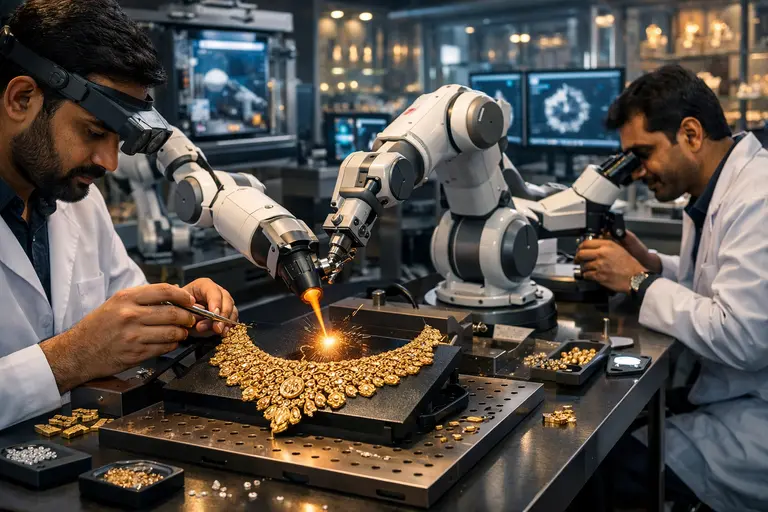
AI-driven machinery can handle repetitive tasks while artisans focus on intricate work. As a result, production time has been reduced by up to 20% in pilot programs at De Beers Group.
Challenges & Considerations
- Preserving Human Touch: AI should support artisans, not replace them. Otherwise, the jewellery may lose emotional appeal.
- Governance & Ethics: AI decisions must align with industry standards and ethical practices. Moreover, governance prevents misuse.
- Industry Adoption: Traditional companies often hesitate to experiment. Therefore, creating “safe to fail” spaces encourages calculated innovation.
Case Studies
- BA111OD Watches: Uses AI for design mockups but preserves manual finishing. Thus, brand identity remains intact while prototype cycles shorten.
- Gübelin Gem Lab: Employs AI for gemstone grading, improving accuracy without replacing expert gemologists. Accuracy improved by 15–20%, showing that AI can complement human expertise.
Q&A
Q1: Will AI replace artisans in jewellery?
A1: No. AI enhances efficiency but cannot replicate creativity and emotional depth. Instead, it supports artisans.
Q2: How can companies integrate AI responsibly?
A2: By establishing governance frameworks, monitoring AI outputs, and creating “safe to fail” experimental environments. This approach reduces risk.
Q3: Are there measurable results from AI adoption?
A3: Yes. Some companies report up to 25% faster design iterations, 20% reduction in production time, and 15–20% improved gemstone grading accuracy. Therefore, the benefits are tangible.